A Sticky Situation at the Albert County Museum

The Albert County Museum has many stories to be told.  In our display called ‘Wonderful Winter’ we have several artefacts that help tell one such story: Maple Syrup!

The Natives were the first to harvest sap to make maple syrup in Albert County.  To extract the sap from the maple trees, the natives would cut an upward slash in the tree and place a reed or sliver of wood in the cut.  The sap would run up the tree, get stopped by the reed then follow the reed out and drip into a birch bark container called a cassa.  The cassas would also be used to evaporate the sap down to make syrup.  They would heat rocks in a fire then place the cassa on the hot rocks to heat the liquid inside.  It was a long process but eventually enough of the water would evaporate away leaving a delicious sweet syrup.

When the French and then subsequently the English settled in Albert County, natives taught them how to extract maple syrup and use it as food.  The first commercial production of maple syrup in Albert County was in the early 1840’s by the Colpitts family.  In their first year of production they gathered enough sap to produce 6200 pounds of maple sugar.  All the sap was gathered in birch bark cassas!  The annual output of maple sugar from the Parish of Elgin was approximately 80,000 pounds.  (1851 Census data.)  It takes 40 gallons of sap to make one gallon of syrup.  It takes one gallon of syrup to make 8 pounds of Maple Sugar.  When you do the math that means that 400,000 gallons of sap were collected to make the 80,000 pounds of sugar.

The cassas were replaced with tin in the 1800’s.  Tin rusts so it was replaced by what was called English tin.  The welds of English tin contain lead and some cans were even lined with lead to keep them from rusting.  Galvanized metal was developed in the early 1900’s after discovering the harmful effects of the lead-lined English tin.  The lids for the cans were developed shortly after the galvanized metal cans.  The first lids were just cut metal but because the edges were sharp they started rolling the edges.  The sap would be transferred from the cans to carrying buckets and then poured into the gathering tank.

The large gathering tank would be placed on a sled and drawn by a horse.  The inverted conical shape of the top is to allow the sap to be poured from the sap cans and it would run down to the center and through the filters to remove any twigs or debris that fell in the open cans.  The shape also prevents the sap from splashing out of the top opening as it is being transported over uneven snow.

The sap was brought to large storage tanks where it could then feed into the evaporator.  The large evaporator on display at the museum was brand new in 1950.  It is a commercial sized evaporator that cannot be used today because it is made of English tin.  Today’s health regulations require stainless steel.  The sap flows in through the pipe to boil in the large vat.  The flow is controlled by the float.  As the water evaporates and the level drops, the float opens the pipe to allow more sap in.  The large vat is ‘fluted’ to create a much larger surface area for heat transfer therefore increasing the efficiency.  As it boils down, the sap transfers to the smaller vat by a float control as well.  In the smaller vat the sap flows through each section as the density changes until it is ready to bottle.

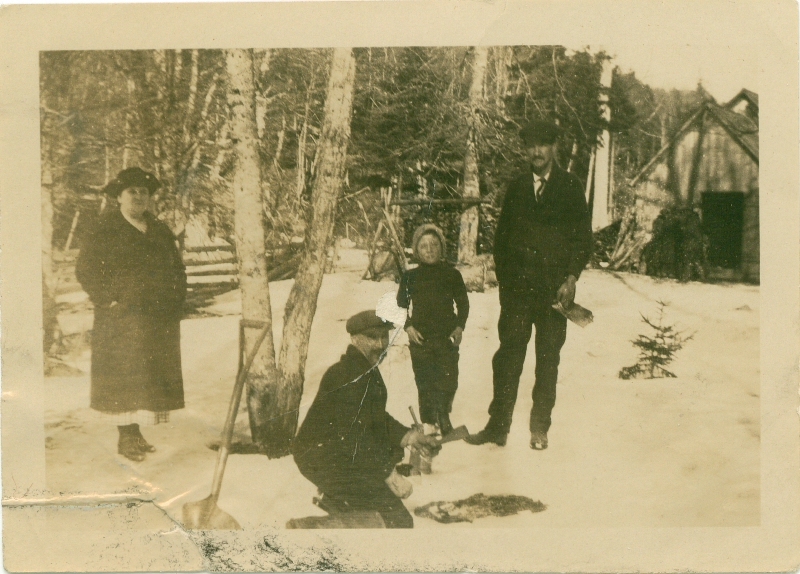
The cauldron beside the evaporator is another way of boiling sap down to syrup for families that just wanted to make their own supply.  It would be suspended over an open fire as depicted in the picture.

Eastman Steeves 5 small.jpg

The picture relates to Eastman Steeves and his family’s sugar camp in Rosevale, Albert County (the back side of Caledonia Mountain.)

After syrup is made it can be boiled down further to make maple candy or maple sugar.  This was usually done in a large pan on a cook stove.  Maple candy is made by boiling syrup to a specific temperature then taking it outside and pouring it over the snow.
The sugar camp where most of the equipment on display came from did not have a thermometer so they found a very unique stick that branches out in four directions from a single point creating fingers where they would place a snowball and then dip it in the boiling syrup.  If the candy formed properly on the snowball, they knew it was ready.

When making maple sugar it naturally wants to form lumps, a masher would be used to mash the lumps out.  Once the sugar was ready it would be placed in maple sugar moulds – ½ pound and 1 pound sizes were popular for commercial resale.  Wood paddles were used for working the sugar into the moulds.  Maple sugar and maple cream are actually the same thing.  When rationing of sugar was introduced in Canada during WW II maple sugar producers decided to change the name from sugar to cream so that it would not be subject to rationing.

Museum's 2015 Special Events Calendar - Something For Everyone!

May 6, 2015 (Wednesday)

Anglophone East School District Regional Heritage Fair

Public viewing of student projects 2:00pm -3:30pm

Awards Ceremony in Courthouse 3:30pm


Mother's Day Supper

May 10, 2015 (Sunday) at 6:00pm

Garlic Roasted Chicken Breast Dinner

Advance Tickets $12 (no tickets at door)


Farmer's and Crafter's Market

May 16th to October 10th, 2015 (Every Saturday)

9:00am-1:00pm

Local foods and crafts...grown, harvested and made right

here in Albert County. Breakfast available 9:00am-12 noon.


Official Museum & Market Opening

May 16, 2015 (Saturday)

Come out to celebrate the start of another season.


Mystery Box Talks

Last Friday of Each Month (May-September) 7:30PM

Treasures from the Vault. What's in the box? We don't know!


100th Anniversary Dinner for the 26th Battalion Sailing

June 12, 2015 (Friday) 6:00pm

Fundraising for Victory Cannon Campaign

Advance tickets $25.00 (no tickets at door)


Commemoration of 100th Anniversary (to the day)

Departure of 26th Battalion June 13, 1915 from Saint John

June 13, 2015 (Saturday) 2:00pm-5:30pm

Royal New Brunswick Regiment and RCMP Pipes and Drums Band Parade


Father's Day Supper

June 21, 2015 (Sunday) at 6:00pm

Treat Dad to a delicious lasagna dinner.

Advance Tickets $12 (no tickets at door)


Fifth Annual R. B. Bennett Day

July 4, 2015 (Saturday)

9am - 4:00pm (FREE ADMISSION)

Come celebrate the birthday of Canada's 11th Prime Minister


Quilt Show & Sale (Admission $2.00)

July 7 to 11, 2015 (Tuesday - Saturday)

9:30am – 5:30pm

Display & sale of hand crafted quilts and goods.


NB Day Lobster Supper

August 3, 2015 (Monday)

Community Hall 5:00pm-8:00pm

Advance Tickets $25 (also tickets at door)


Royalty Tea

August 12, 2015 (Wednesday)

2:00pm

Advance Tickets $12 (no tickets at door)


Antique Road Show

September 20, 2015 (Sunday)

2:00pm – 4:00pm

Have your antiques appraised

($5.00 per item or 3 for $10.00)


Albert County Historical Society

Annual General Meeting

October 15, 2015 (Thursday)

7:30pm in Community Hall


Christmas Concert

November 21 (Saturday) & 22, 2015 (Sunday)

Festive music, singing, dancing, drama & refreshments

Sat. Nov. 21 at 7:00pm Sun. Nov. 22 at 2:00pm

Advance tickets $12.00


98th Anniversary Update - Vimy Ridge and the Victory Cannon Campaign

It was 98 years ago today, (April 9, 1917)  that the Canadian Expeditionary Force (CEF) fought the Battle of Vimy Ridge. It was the first time the Canadian Corp fought together as a single unit and achieved the first Allied Victory of the War. It was also the day the 27th Battalion captured the K14 10.5cm Cannon that sits in Hopewell Cape Square, which the people of Albert County won in the 1919 Victory Loans Competition for raising the greatest percentage over their target anywhere in New Brunswick. The County raised almost 3 times their goal of $110,000.00 with a realized sum of $317,000.00 (6.92 million in today's dollars). 

So today while we pause and remember the sacrifices of the Canadians on that day almost 100 years ago, it's fitting to give an update on our own campaign to restore their captured trophy. The Victory Cannon Campaign has raised $4704.40 to date of a goal of $15000.00, we are within arms reach of 1/3 of our goal. So please donate. CLICK TO DONATE

The cannon wheels are in the process of being restored, our Wheelwright Mike Hartigan has been kind enough to send some photos of his progress. 

Old spokes on new oak blanks, this is where we set the pattern for all the other spokes. One of the hubs and some felloe sockets are in the background.

Roughing out a spoke on the bandsaw removing excess wood.

Marking out the rough cuts for the cheeks on the hub end of the spoke.

Marking out the rough cuts for the cheeks on the hub end of the spoke.

Rough cut spokes laid out in front of their intended new home.

Rough cut spokes laid out in front of their intended new home.

Practice spoke blank mounted on the lathe.

Rough turned spoke ready for finishing.  Each of the 24 required spokes will be individually shaped by hand using a spoke shave.

Cracking the stud nuts on the hub.  Some of them are really on there! 

Cracking the stud nuts on the hub.  Some of them are really on there! 

Now that's a story worth saving!

The Victory Cannon Campaign is raising funds to restore the two captured World War One cannons that sit in Hopewell Cape. These cannons were captured by Canadians during the Great War, and were awarded to the people of Albert County. You can donate online to the Victory Cannon Campaign here, and best of all you'll be sent a tax receipt!  Click Here to Donate!

Reconnecting With the Heroes of the Past - A Modern Marvel

Did you know that the Canadian Government is in the process of digitizing all the Great War Service Records? It is a fantastic way to reconnect with the men who served in the Canadian Expeditionary Force during World War One. All you need to know is the full name of someone who served and plug it into the search fields. 

During a recent search I was able to find the service records for my Great-Grandfather who joined the 116th Ontario County Battalion on September 15, 1915.  He was transferred to the 18th Battalion (Western Ontario)  on arrival in France. He fought at Vimy Ridge and was wounded on August 15, 1917 at the Battle of Hill 70, with gun shot wound to the right arm. After healing from that he was sent back to the front and was wounded again on June 2, 1918 by a high velocity shell fragment to his chest and his back. This wound ended his fighting days at the front, and he was eventually discharged on January 28, 1919. 

The interesting thing is that there is a wealth of secondary information found in these documents, like the address he was living at. Which I was able to plug into Google and find the house which still stands. The papers also listed that his father was deceased but his mother was still living, giving her address too. We also know how much he weighed, his height (5'3"), hair colour, eye colour, etc. it's an amazing way to touch base with your ancestors.  

Not every soldier has the full service records digitized yet, but the least they will have is the Attestation Papers, where they signed up to the C.E.F.. Keep checking back to the site because they add complete records all the time, and there is a spot to request documents. 

You can find the site at Library and Archives Canada HERE. 

As a footnote the 18th Battalion fought with the 2nd Division, where both the 26th New Brunswick Battalion and the 27th Winnipeg Battalion who captured the gun that sits in Hopewell Cape fought. It all ties in. 

Now that's a story worth saving!

The Victory Cannon Campaign is raising funds to restore the two captured World War One cannons situated in the square in Hopewell Cape. These cannons were captured by Canadians during the Great War, and were awarded to the people of Albert County. You can donate online to the Victory Cannon Campaign here, and best of all you'll be sent a tax receipt!  Click Here to Donate!


The More You Dig the Better the Story.

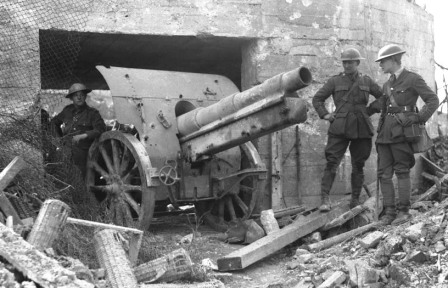
The large 10.5 Cm K14 German Cannon that sits in the square in Hopewell Cape, was captured at Vimy Ridge, April 9, 1917, and was won by the Citizens of Albert County during the Victory Loans Campaign of 1919 for raising the greatest percentage of monies over their set goal. They raised $317,000.00 almost tripling their goal of $110,000.00. Now that is a pretty impressive resume for a gun, but the story gets better. 

One of the consequences of the massive artillery bombardment during the attack on Vimy Ridge, was the absolute destruction of the terrain, and this coupled with the rain and snow made the ground almost impassable with mud. Once the Canadians gained control of their objectives they tried to move their artillery forward but found the ground just swallowed up the massive artillery pieces. At the end of day two of the battle (April 10), only a few pieces had been moved forward enough to be of any service. 

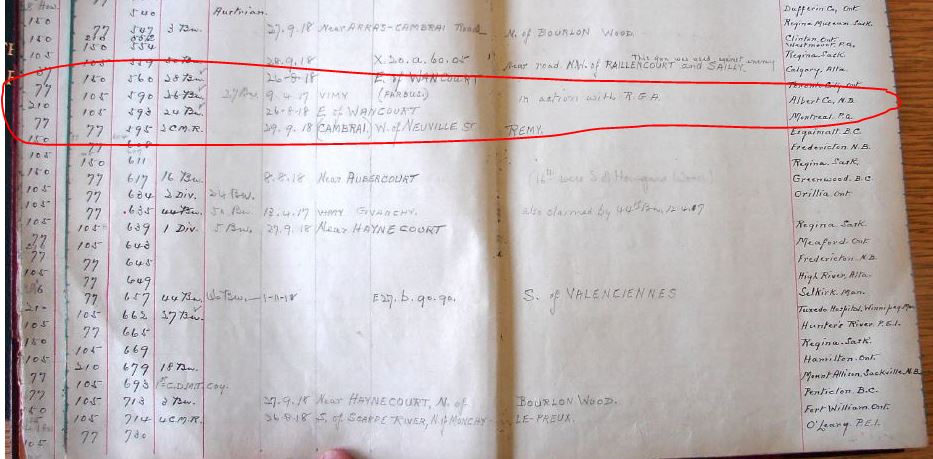
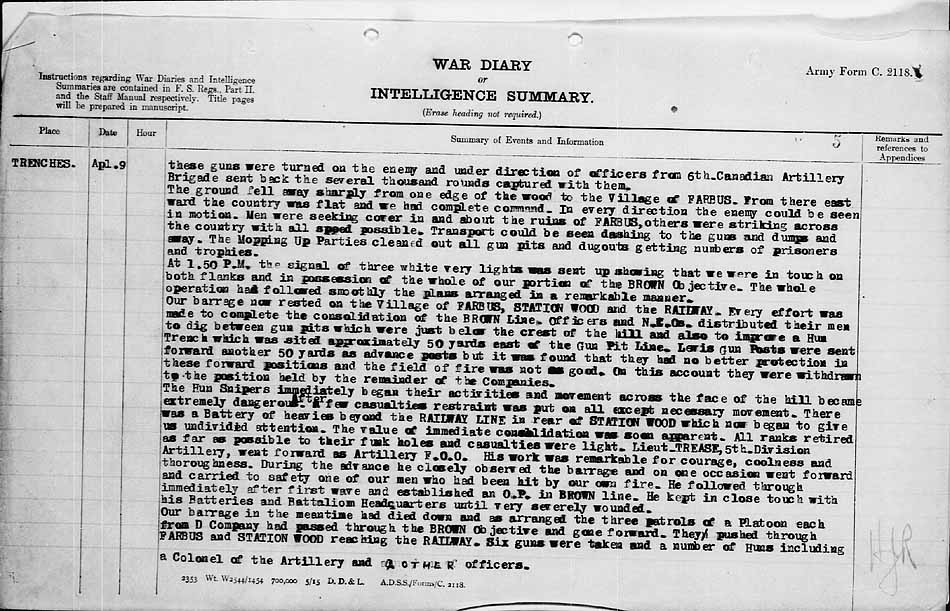
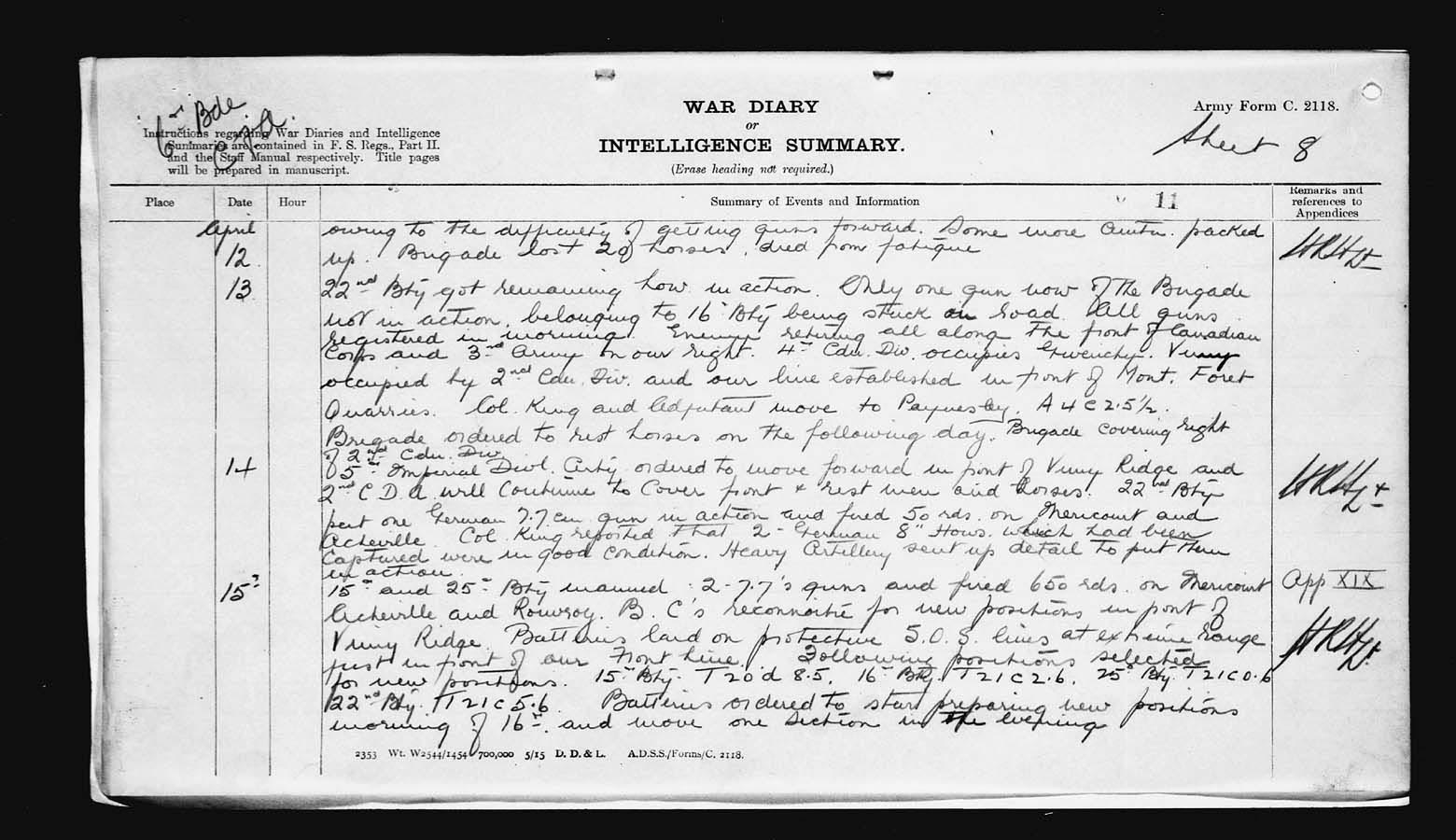
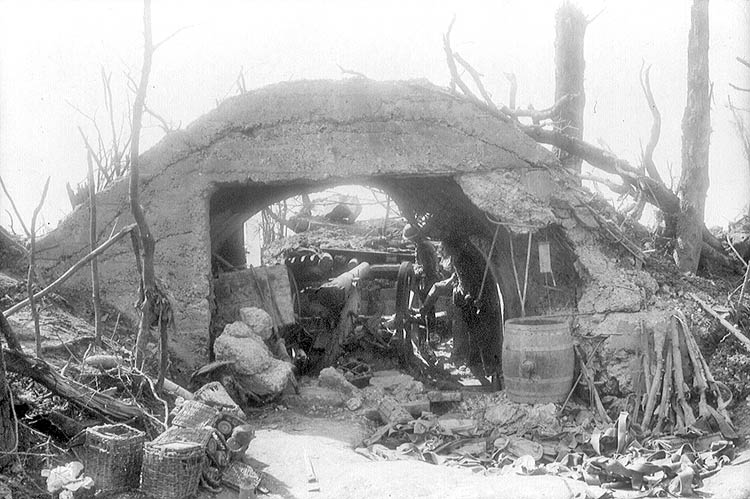
The Canadians then seized some of the captured German guns and put them into action.  The 6th Canadian Artillery Brigade records sending up a heavy artillery crew to put the K14 in action. In the War Diaries of the 27th Battalion it records several thousand rounds being sent back to the Germans on the guns they captured. It is also recorded in the War Trophies Allocation Report of 1920 that the cannon was used by the RGA. 

So not only was the gun used by the Germans against the Canadians, but the Canadians turned the gun around and used it against the Germans. There are not many guns in existence who fought on  both sides during the war. 

Now that's a story worth saving!

The Victory Cannon Campaign is raising funds to restore the two captured World War One cannons situated in the square in Hopewell Cape. These cannons were captured by Canadians during the Great War, and were awarded to the people of Albert County. You can donate online to the Victory Cannon Campaign here, and best of all you'll be sent a tax receipt!  Click Here to Donate!

Location, Location Location - Location is Everything!

How many times have you heard the adage "Location, Location Location - Location is Everything!" well in terms of Real Estate it couldn't be truer, but it's also true in the telling of history. Take for example the captured German 10.5cm K14 Cannon located in the square in Hopewell Cape, not only do we know what battle it was captured in, and who captured it, but we know the exact location on the battlefield where it was captured, and can visit that location today via the web. 

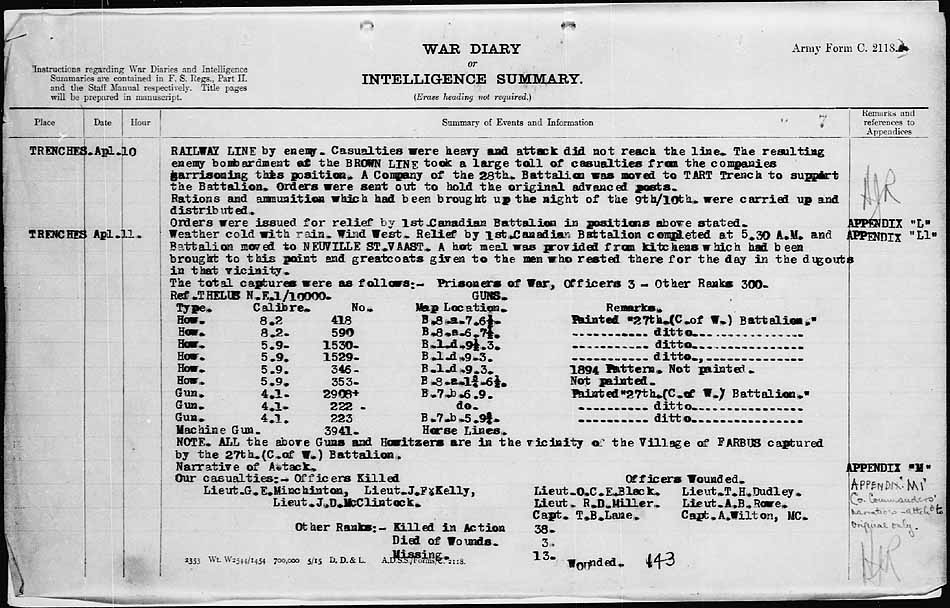
We have to thank the men of the 27th Battalion for keeping such detailed records of their accomplishments on that snowy day in April almost 100 years ago. From their Battalion diaries, in the Intelligence Summary we see the cannon with the serial number 590 was captured at B8.a6.7.1/2 on the Thelus N.E. 1/10000 map. (The map is shown in the photo gallery). Once we find the spot on the map, we can then correlate it to a modern map via Google Earth, and can almost pinpoint it's location today. 

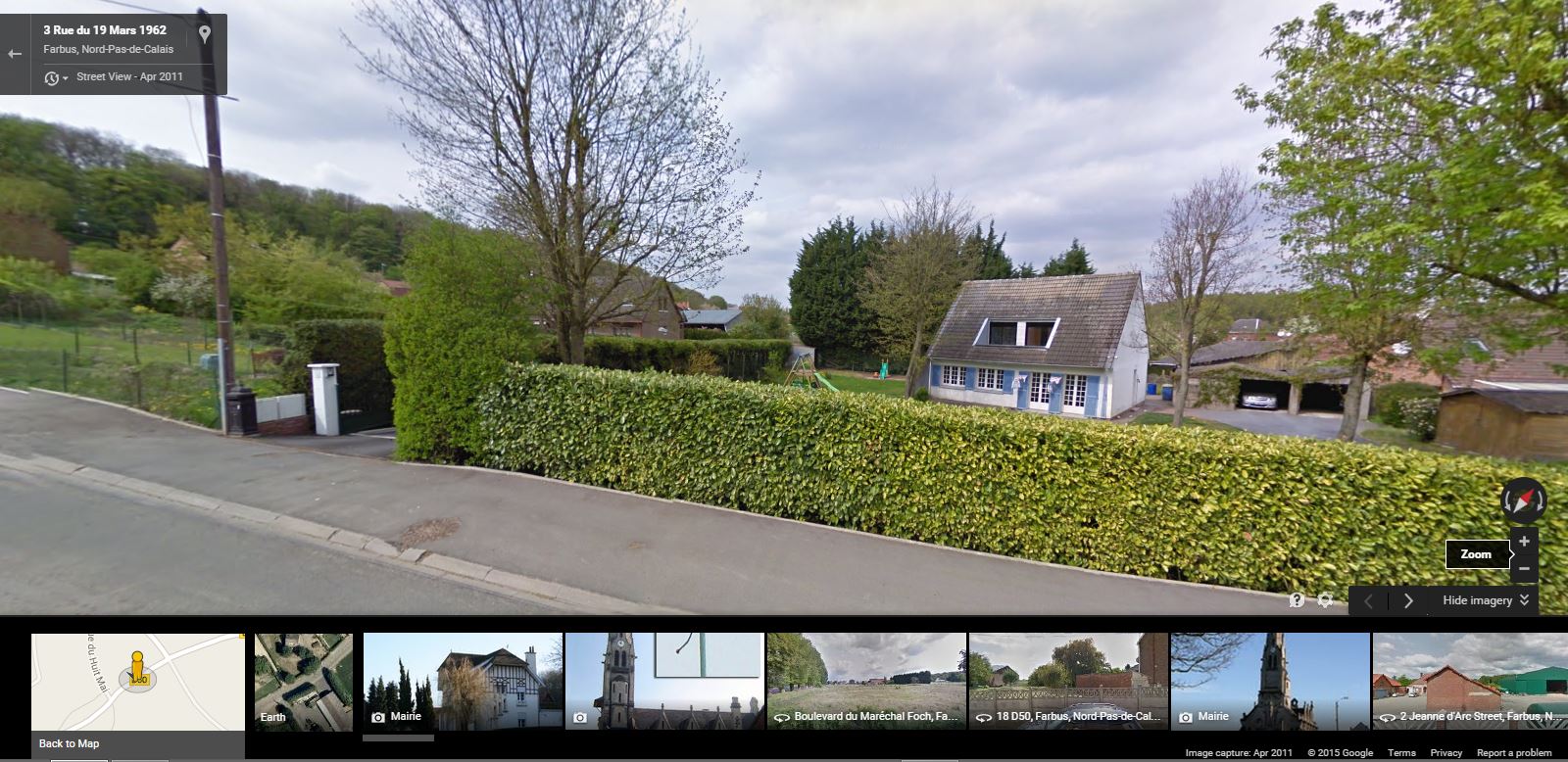
If we look at the large map we can see the road still has the same curve, the forest is still there on the right, and the left. The basic flora and topography of the map in 1917 is the same today.  Then we zoom in to road level we can see that where a tool of mass destruction stood in 1917, a child's playground now stands.  It's amazing that we know so much about an event that happened almost 100 years ago. 

Now that's a story worth saving!

The Victory Cannon Campaign is raising funds to restore the two captured World War One cannons situated in the square in Hopewell Cape. These cannons were captured by Canadians during the Great War, and were awarded to the people of Albert County. You can donate online to the Victory Cannon Campaign here, and best of all you'll be sent a tax receipt!  Click Here to Donate!


The Riverside Consolidated School - Some Little Known Facts

If you haven't heard the Riverside Consolidated School could be closed as early as June, 2015. Here is a link for further news and who you can write to in support of the school. 

  http://www.connectingalbertcounty.org/culture--heritage/request-for-support-for-riverside-consolidated-school

Some Facts on RCS: 

  • Construction of the Riverside Consolidated School began in July of 1904.
  • Designed by architect, W. E. Reid, who was the youngest of three sons who all followed the same profession. He was born in Harvey, New Brunswick to William J. Reid and Lucinda Robinson. He studied at Mount Allison University and about 1888, he joined his brothers James W. and Merritt in California, where he ran their San Diego office, overseeing construction of the massive Hotel del Coronado to his brother's designs. He returned to Canada in 1899 and had a few commissions there under the auspices of Senator Abner Reid McClelan. These included the Riverside Consolidated School and the Albert County Court House.
  • The consolidated school cost $20,000 to build and included eight class rooms, an office, two lunchrooms, a library, a laboratory, and two playrooms. (This would be about $420,000.00 today) 
  • The construction was partially funded by a $5000 donation from Riverside resident and former Lieutenant-Governor of New Brunswick, Abner Reid McClelan, with the stipulation that manual training, household science, and nature work classes were to be provided, in addition to the more traditional subjects. The province paid $1,000 and the remaining $14,000 was paid by local taxpayers.
  • Riverside Consolidated opened in September of 1905, 225 students filed through the doors and experienced the most modern facilities available at the time. The school had five departments and staff of seven teachers. The Albert County Grammar school was one department, enabling students to prepare for University Matriculation. The other departments included Household or Domestic Science, manual Training, Agriculture and school Gardening.
  • The new school was staffed by seven teachers and a janitor.
  • Students were brought by horse-drawn van from surrounding communities like Chester, Beaver Brook, Midway, Harvey, and Hopewell Hill during the spring and fall and by horse-drawn sleigh during the winter.
  • The formal opening ceremony took place June 15, 1906. New Brunswick Premier Tweedie, Chief Superintendent of Education, J.R. Inch and many other officials arrived by way of the steamer “Wilfred C.” at the Riverside Wharf. There they were met by Honourable A.R. McClelan and the drum and bugle of Albert performed.
  • Premier Tweedie as well as many other dignitaries were all quite impressed with the new facility, declaring it a model for other educational facilities across the Province.
  • Today after 100+ years of operation, the Riverside Consolidated School is the oldest operating consolidated school in New Brunswick. Children from communities as far away as Lower Cape and Alma, attend the school from kindergarten to grade five.
  • Historic Places Link

Prepare to be Be-dazzled - Part 3 Dazzle Camouflage

PABLO PICASSO (1881-1973)
'Factory, Horta de Ebbo', 1909 (oil on canvas)

The cannons in Hopewell Cape were not always painted the drab grey they are now, but in multi-coloured geometric shapes in bright greens, browns and even orange. This was to counter the Optical Range Finder which could pin-point the location of a ship or cannon with deadly accuracy. The purpose of the multi-coloured shapes and designs was to confuse the operator of the Range finder so they could not accurately line up the ship or cannon in the range finder. 

So where did the idea for this come from? Surprisingly the world of art, and in particular the movement called Cubism. The idea behind cubism is to take a shape that exists in the world as we perceive it naturally, break it up into different constituent pieces, and then reconstruct it in a way that appears almost alien to the human eye, mainly by painting those pieces from several different points of view simultaneously. Pablo Picasso is the most famous Cubism painter, and you can see his Factory painting to the right. 

It was the French (and soon afterward the Germans and British) who realized that some of the same aesthetic principles behind cubism could be put to use breaking up the otherwise easily distinguishable shapes of distant objects. Painting potential targets in ways designed to break down their form makes it difficult for adversaries to line those images up properly, particularly at longer distances where atmospheric effects, battlefield smoke, surrounding terrain and other factors can make even an undisguised target difficult enough to fixate accurately.

In other words, dazzle camouflage was intended so that  you could never be quite sure just what you're looking at, especially when you view it through an optical range-finder. If you can't line up what you're looking at you can't determine the range and location of the piece, so you can't hit it accurately from a distance. 

The museum plans on restoring the two German cannons to their as captured condition painted in the original dazzle camouflage. You will definitely notice them as you're driving by. 

Now that's a story worth exploring!

The Victory Cannon Campaign is raising funds to restore two captured World War One cannons situated in the square in Hopewell Cape. These cannons were captured by Canadians during the Great War, and were awarded to the people of Albert County. You can donate online to the Victory Cannon Campaign here, and you'll be sent a tax receipt!  Click Here to Donate!


Prepare to be Be-Dazzled Part 2 - The Optical Range finder

The Cannons in Hopewell Cape used to be painted in Dazzle Camouflage to disrupt the Optical (Coincidence) Range Finder. Which was developed by an American in 1890. The range finder is basically a pair of binoculars, with the eyepieces normal distance apart, but the objective lenses spaced very far apart. Such that when you look through the device at, say, a German Battleship, you see an image that looks like the one to the right.

Note that the very top of the mast is off by just a tad--the images from the two objective lenses do not quite match up. The range-finder operator then adjusts the knobs on the range-finder until the mast lines up exactly. See figure to the right. 

By some very basic trigonometric principles you can then calculate the distance to the target to a very high degree of precision. Note that in order to use the device properly, the operator needs to have a good idea of what, exactly, he is looking at so he can match up the images properly.

Once the Americans came up with this, every major power at the turn of the 20th c. invested in it even further, and all the major powers used range-finders to guide their naval guns and field artillery. Next week we'll introduce the invention of dazzle camouflage. 

Now that's a story worth exploring!

The Victory Cannon Campaign is raising funds to restore the two captured World War One cannons situated in the square in Hopewell Cape. These cannons were captured by Canadians during the Great War, and were awarded to the people of Albert County. You can donate online to the Victory Cannon Campaign here, and best of all you'll be sent a tax receipt!  Click Here to Donate!

Prepare to be Be-dazzled.

Did you know the cannons in Hopewell Cape were not always painted the drab grey they are now, but multi-coloured in bright greens, browns and even orange? Quite often the camouflage used in World War One was not solely used to hide something, but to make it more difficult to determine its true distance and range for artillery bombardment. The term was Dazzle Camouflage, and it was developed to counter the newly devised optical (coincidence) range finder. 

In 1890, US Navy Rear Admiral Bradley Fiske was granted a patent for an optical device that was to have enormous implications for both naval and land-based warfare in the next several decades: the range-finder.

Prior to the advent of the coincidence range-finder, deciding how high or low to elevate your guns in order to hit a distant target usually meant having to guess how far away it was. But thanks to Fiske's range-finder device, you could now determine precisely how far away an enemy ship was before wasting your first salvo. So how did the Coincidence Range Finder work and how did Dazzle Camouflage counter it? Come back  next week for the answer. 

Now that's a story worth exploring!

The Victory Cannon Campaign is raising funds to restore the two captured World War One cannons situated in the square in Hopewell Cape. These cannons were captured by Canadians during the Great War, and were awarded to the people of Albert County. You can donate online to the Victory Cannon Campaign here, and best of all you'll be sent a tax receipt!  Click Here to Donate!

A Walk with the Men - The Secret War Diaries of the 26th Battalion

The majority of the men who joined the Canadian Expeditionary Force (CEF) from Albert County joined the 26th Battalion, The New Brunswick Battalion.

The famed "Fighting 26th" participated in all of the major battles in which the Canadian Corps was involved: Mount Sorrel; Somme 1916, 1918; Flers-de Courcelette; Thiepval; Ancre Heights; Arras 1917, 1918; Vimy 1917; Arleux; Scarpe 1917, 1918; Hill 70; Ypres 1917; Passchendaele; Amiens; Hindenburg Line; Canal du Nord; Cambrai 1918; Pursuit to Mons. The battalion was disbanded on 30 August 1920. The 26th is continued today by the Royal New Brunswick Regiment.

You can follow the battalion from its birth in Saint John to the final disbanding in 1920 by reading its Secret War Diaries. They begin in November 1914 and end in May 1919 and give a fascinating glimpse into the life of the battalion at war. 

1914/11/02-1917/07/3

1917/08/01-1918/06/30 

1918/07/01-1919/05/10  

Now that's a story worth exploring!

The Victory Cannon Campaign is raising funds to restore the two captured World War One cannons situated in the square in Hopewell Cape. These cannons were captured by Canadians during the Great War, and were awarded to the people of Albert County. You can donate online to the Victory Cannon Campaign here, and best of all you'll be sent a tax receipt!  Click Here to Donate!